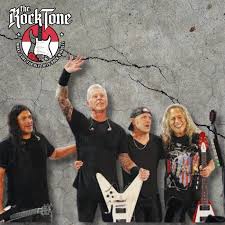
For decades, Metallica has been synonymous with volume, velocity, and force. Stadiums shaking. Amplifiers pushed to their limits. Music that does not ask for permission. So imagine the shock if, at the height of the Super Bowl halftime spectacle, they chose the opposite.
No explosions. No walls of sound.
Just four figures walking onto a darkened field as the lights fall away and the noise fades into a low hum of expectation.
This is the moment few would see coming and none would forget.
James Hetfield steps forward, not with a roar, but with a breath. The guitar is acoustic. The tempo is restrained. The opening notes ring out clean and exposed, leaving nowhere to hide. In a stadium built for chaos, silence becomes the loudest thing in the room.
Metallica has always been at its most powerful when it tells the truth. Beneath the distortion and aggression has always lived a band unafraid of vulnerability. Songs about loss, regret, endurance, and survival. Songs that confront rather than comfort. Strip away the volume and what remains is songwriting forged in honesty.
This imagined halftime show would not be about proving dominance. It would be about command. The confidence to slow the world down and trust that millions will lean in rather than tune out.
Lars Ulrich trades pounding drums for restraint. Kirk Hammett lets space do the talking between notes. Robert Trujillo grounds the performance with a pulse that feels like a heartbeat rather than a blast. The band does not perform at the crowd. They invite the crowd inside the song.
And something shifts.
Phones lower. Conversations stop. A stadium that came prepared for spectacle finds itself caught in reflection. In that moment, the Super Bowl becomes less about celebration and more about connection.
This is what truth sounds like when it is not competing for attention.
Metallica has earned the right to do this. Few bands could walk onto the biggest stage in the world and dare to be quiet. Fewer still could hold it in the palm of their hand. Their legacy allows them to break the rules because they helped write them.
The power of such a performance would ripple far beyond the halftime clock. It would challenge assumptions about what mass entertainment must be. It would remind audiences that heaviness is not measured in decibels. Sometimes it is measured in honesty.
In a culture saturated with noise, restraint becomes revolutionary.
If Metallica ever chose this path, the headlines would talk about courage rather than volume. Critics would debate whether it was the boldest halftime show ever attempted. Fans would remember where they were when a metal band taught a stadium how to listen.
Not by shouting.
But by telling the truth and trusting it to carry.
And it would.