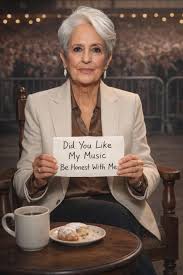
At 84 years old, Joan Baez has received an honor that feels less like an award and more like a long overdue acknowledgment of impact. She has been named one of the most influential living artists in the history of music and entertainment, a distinction that reflects not just her sound, but the moral force she carried into every note she ever sang.
Baez did more than perform songs. She gave them purpose.
Emerging from the folk revival of the early 1960s, her clear soprano cut through a noisy world with uncommon calm and conviction. While others chased fame, Baez chose meaning. Her music became inseparable from the civil rights movement, the antiwar movement, and the broader struggle for human dignity. She did not sing about change from a safe distance. She stood inside it.
Songs like “Diamonds & Rust,” “We Shall Overcome,” and her interpretations of traditional ballads were never just performances. They were statements. Invitations to listen more closely. Reminders that art can carry conscience without losing beauty.
Her influence reaches far beyond her own catalog. Baez helped introduce the world to Bob Dylan, stood shoulder to shoulder with Martin Luther King Jr., and used her platform to amplify voices that power preferred to ignore. In doing so, she redefined what it meant to be an artist in public life. Fame, in her hands, became a responsibility.
What makes this recognition resonate so deeply is Baez’s refusal to fade quietly or soften her values. Even after stepping away from touring, she continues to speak, write, and create. Her recent years have shown an artist at peace with her legacy, but never detached from the world around her.
Generations of musicians cite her not just as an influence, but as a compass. From folk and rock to protest music and modern singer songwriters, Baez’s imprint is everywhere. You hear it in voices that choose honesty over polish, courage over comfort.
At 84, Joan Baez stands as proof that influence is not measured by charts or sales, but by endurance. By how long the echo lasts after the final note.
This honor does not mark the end of her story. It confirms what many already knew. Joan Baez did not simply witness history. She helped sing it into being.