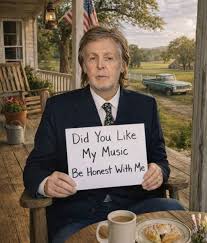

At 82, Paul McCartney is still doing what he has always done best: quietly shaping the world around him. This week, that influence was formally acknowledged when he was recognized as the most influential living artist in music history, a distinction that feels less like an award and more like a statement of fact long understood across generations.
McCartney’s impact is so vast it can be difficult to summarize without sounding hyperbolic. As a songwriter, he helped redefine what popular music could be. As a performer, he turned melody into memory. As a cultural figure, he became part of the emotional fabric of the last six decades. Few artists can claim that their work has been present at so many pivotal moments in people’s lives.
From his early years with The Beatles, McCartney helped spark a creative revolution that reshaped music, fashion, youth culture, and even the business of art itself. Songs like “Yesterday,” “Hey Jude,” and “Let It Be” did not simply top charts. They entered the collective conscience, crossing borders, languages, and generations with ease.
What makes McCartney’s influence singular is its longevity. Many artists define an era. McCartney has moved through multiple eras while remaining relevant in each one. His post-Beatles career, from Wings to his solo work and collaborations with younger artists, proved that reinvention does not require abandoning identity. It requires curiosity.
Even now, his live performances continue to draw massive, multi-generational audiences. Teenagers sing along beside grandparents. The songs remain familiar, but they never feel frozen in time. That ability to endure without becoming nostalgic is rare, and it is central to why McCartney’s influence continues to grow rather than fade.
Those close to him often note that McCartney does not dwell on legacy. He talks about songwriting as a daily practice, about joy in creation, about staying open. That mindset may be his greatest lesson to the industry he helped build. Influence, in his case, is not about dominance. It is about generosity. About giving the world melodies it can carry forward.
The recognition at 82 is not a farewell or a final chapter. McCartney is still recording, still performing, still surprising audiences with his energy and warmth. The honor simply places language around what music lovers have known for years. His work did not just soundtrack history. It helped write it.
In an age where trends turn over at dizzying speed, Paul McCartney stands as proof that true influence is measured not by virality, but by permanence. His songs remain alive because they speak to something timeless. Love. Loss. Hope. Resilience.
Honoring him now feels less like crowning a king and more like acknowledging a constant. Paul McCartney did not just change music. He showed the world how music can change people, again and again, without ever losing its soul.