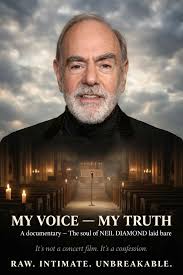
There are documentaries that catalog a career, and then there are documentaries that reveal a life. My Life – My Way belongs firmly in the latter category. It is not built to impress. It is built to tell the truth. And in doing so, it offers one of the most intimate portraits ever captured of Neil Diamond.
From the opening moments, the film makes its intention clear. This is not a greatest-hits parade or a nostalgia exercise. There is no rush to celebrate milestones or tally achievements. Instead, Diamond speaks in measured tones, reflective and unguarded, as if the camera is not there to record him, but to listen.
The title is not a slogan. It is a statement of fact.
The documentary traces Diamond’s journey from Brooklyn to global stages, but it avoids the mythmaking that often surrounds legends of his stature. Success is shown alongside sacrifice. Fame is paired with isolation. The songs that united millions are placed beside the loneliness that followed the applause.
What makes the film so affecting is its restraint. Diamond does not dramatize his struggles. He names them. His battles with identity, creative pressure, and health are discussed plainly, without self-pity or performance. When he speaks about stepping away from touring after his Parkinson’s diagnosis, the moment lands not as tragedy, but as acceptance.
There is power in that acceptance.
Music remains the backbone of the film, but it is treated as expression rather than product. Songs are revisited not for how they charted, but for what they carried. Love, insecurity, hope, regret. Diamond reflects on how often he wrote what he could not say out loud, and how audiences understood it even when he did not yet understand himself.
Archival footage is used sparingly and effectively. Early performances feel raw and hungry. Later ones feel expansive but heavier, weighted by experience. The contrast reinforces the film’s central theme. Growth is not about becoming louder or bigger. It is about becoming more honest.
Perhaps the most striking aspect of My Life – My Way is its refusal to offer a tidy conclusion. There is no final bow. No attempt to summarize a legacy. The documentary ends where Diamond seems most comfortable now. In reflection. In gratitude. In peace with what has been, and with what no longer needs to be proven.
For fans, the film deepens an already powerful connection. For those less familiar with his work, it serves as an introduction not just to a catalog, but to a man who lived with intensity and chose vulnerability over myth.
My Life – My Way does not ask viewers to remember Neil Diamond as he was at his peak. It invites them to see him as he is. Thoughtful. Clear-eyed. Human.