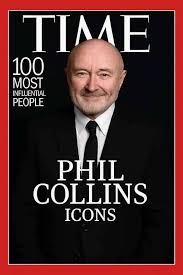
Phil Collins has never needed volume to prove his impact. His influence has always moved quietly at first, then stayed forever. This week, that influence received formal recognition as Collins was named to TIME magazine’s list of the 100 Most Influential People, honoring a career that reshaped popular music and extended far beyond it.
For many, Collins is immediately associated with a voice that feels both intimate and immense. From the unmistakable opening drum fill of “In the Air Tonight” to the emotional clarity of “Against All Odds,” his music has lived inside moments of heartbreak, reflection, and resolve for decades. Yet TIME’s recognition is not only about chart success or longevity. It is about reach.
Collins’ work bridged genres at a time when boundaries were still guarded. As the frontman of Genesis, he helped guide the band from progressive rock complexity into a more accessible, emotionally driven sound without losing artistic credibility. As a solo artist, he proved that vulnerability could coexist with mainstream success. His songs did not hide behind metaphor. They spoke plainly, and people listened.
What sets Collins apart is how deeply his music embedded itself into everyday life. His songs were not just played on the radio. They became soundtracks to personal milestones, late-night drives, quiet reckonings, and shared memories. His ability to communicate emotional truth without theatrical excess made his work feel personal, even when heard by millions.
Beyond music, Collins’ influence extended into film, philanthropy, and cultural conversation. His work on Disney’s Tarzan introduced his voice to a new generation, earning critical acclaim and global recognition. At the same time, his dedication to historical preservation through the Alamo and his charitable efforts demonstrated a sense of responsibility that matched his fame.
In recent years, Collins has faced significant health challenges that limited his ability to perform. Rather than diminish his legacy, that chapter has added depth to it. His final tours were marked not by spectacle, but by gratitude and reflection. Fans did not come expecting perfection. They came to honor a voice that had already given them so much.
TIME’s acknowledgment recognizes something larger than hits or awards. It recognizes endurance. Collins’ influence did not burn hot and fade. It settled in and stayed. His music continues to resonate across generations because it speaks to emotions that do not age.
In an industry often defined by reinvention and noise, Phil Collins built a legacy on sincerity, restraint, and emotional honesty. Being named one of the most influential people in the world is not a surprise. It is a confirmation of what listeners have known all along.
Some artists define an era. Phil Collins defined how that era still feels.