Introduction
On the night of September 9, 1956, the American living room became a battleground. Parents sat frozen on their sofas while their children leaned forward, eyes wide, as something unfamiliar cracked through the black and white glow of the television set. This was not a political speech, not a declaration of war, but it carried the force of both. Elvis Presley was about to step into the most powerful cultural space in the country.
The appearance was meant to be historic even before a single note was sung. The Ed Sullivan Show was the altar of American respectability, a program that defined what was acceptable in family entertainment. Yet the man whose name crowned the show was nowhere to be seen. Ed Sullivan, recovering from a serious car accident, was watching from a hospital bed. In his place stood an unlikely guardian of tradition, the British actor Charles Laughton.
The contrast could not have been sharper. Laughton represented discipline, classical training, and European theatrical authority. Presley, only 21, was broadcasting remotely from Hollywood as a former truck driver from Tupelo whose reputation had already unsettled parents and preachers. As Laughton faced the camera, his posture calm and his voice measured, he introduced the night’s most controversial guest.
“To Hollywood now, to meet Elvis Presley.”
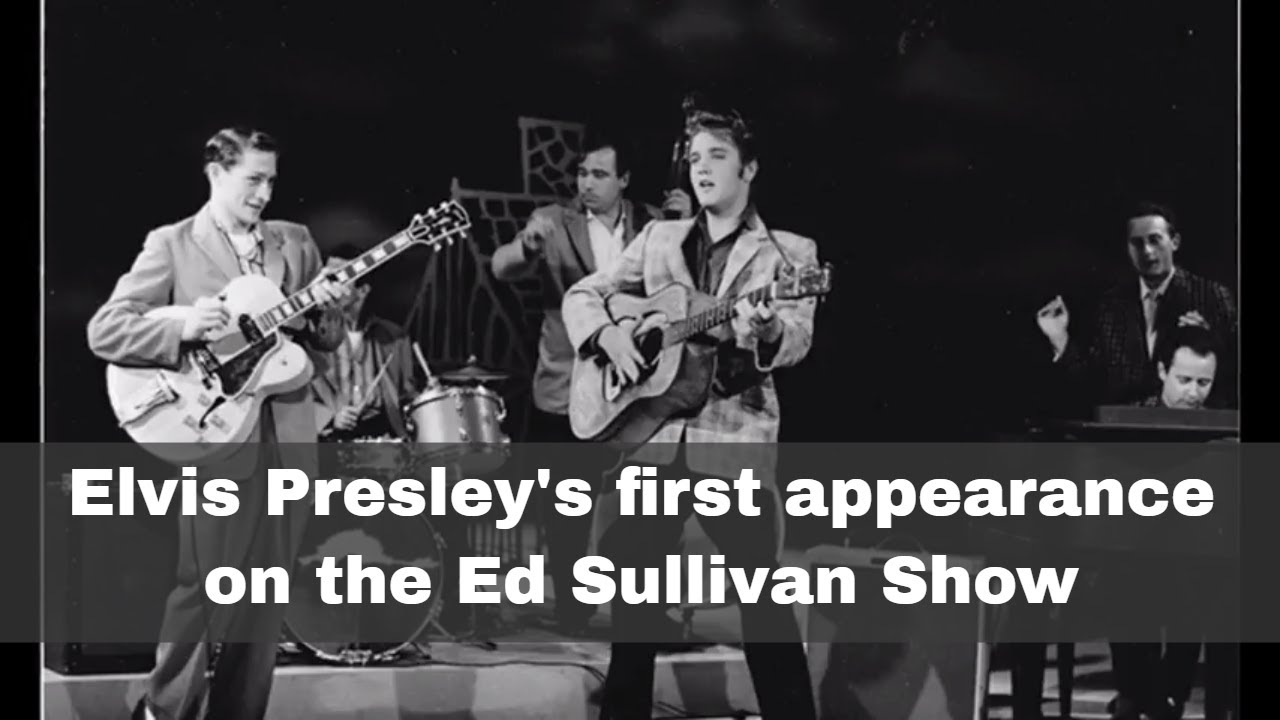
With that sentence, the atmosphere shifted. When the camera cut to CBS Television City in Los Angeles, the sound changed first. A scream tore through the studio audience, high and piercing, a noise that would soon become shorthand for a generation. Presley stood in a plaid jacket that seemed to vibrate under the studio lights, a guitar resting against his body like an extension of his nervous energy.
Time has softened the shock of that image, but watching it again reveals the real tension of the moment. The press had framed Presley as a menace, a corrupter of youth. Yet when he spoke, his voice was gentle, almost shy. He thanked Laughton and the audience with visible sincerity, his Southern accent carrying respect rather than rebellion.
“Thank you, Mr. Laughton, ladies and gentlemen. This is probably the greatest honor I’ve ever had in my life.”
For a brief instant, he looked like the boy next door. Then the music began. As Don’t Be Cruel took shape, the transformation was immediate. His knees bent, his shoulders rolled, and his hips responded to a rhythm that felt both spontaneous and deliberate. The Jordanaires wrapped him in smooth gospel harmonies, but the camera never lost its focus. Every movement, every smile, carried intent.
Contrary to the legend that would follow, Presley was not hidden from the waist down during this first appearance. The camera pulled back, revealing his full frame. What America saw was not obscenity but a new physical language. It was desire translated into motion, bypassing explanation and moving straight into instinct.
The night’s turning point came when Presley slowed everything down. Aware of the criticism that painted him as little more than noise and motion, he introduced a new ballad from an upcoming film for 20th Century Fox. His voice dropped, the studio quieted, and he named the song softly.
“This is a brand new song. It’s called Love Me Tender.”
The screams did not stop, but they changed. What had been wild excitement became something closer to awe. Presley closed his eyes as he sang, his voice tender and controlled. The camera cut to the audience, capturing young women with hands over their mouths and tears forming as they watched something that felt deeply personal unfold in public.
More than sixty million people were watching, an overwhelming majority of the television audience. This was mass intimacy on a scale America had never experienced. It was not simply a performance but a shared emotional event, transmitted live into homes across the country.
Back in New York, Laughton appeared genuinely moved by what he had just witnessed. The expected clash between high culture and popular rebellion never arrived. Instead, there was a quiet acknowledgment that something irreversible had taken place. Even Sullivan, still absent from his own stage, could not deny the numbers or the response.
“I want to say to Elvis Presley and the country that this is a real decent, fine boy.”
That statement, delivered after Sullivan’s return, sealed the transfer of authority. Rock and roll was no longer a passing disturbance. It had been welcomed, however reluctantly, into the mainstream.
As the broadcast came to an end, Presley waved goodbye, his familiar half smile returning. The television screens flickered, then went dark. The living rooms of America fell silent again, but the silence was different now. It was the quiet that follows thunder, heavy with the knowledge that the storm had only begun.