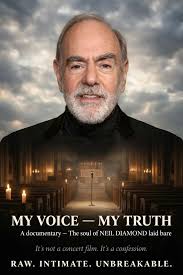
For more than six decades, Neil Diamond has been synonymous with grandeur. Sequined shirts. Sold-out arenas. Anthems that turned strangers into choirs. He built a career on scale and spectacle, on songs that felt bigger than the room they were sung in. That is precisely why My Life – My Way lands with such quiet force.
This documentary is not a victory lap. It is a reckoning.
Rather than revisiting the familiar milestones, Diamond turns inward. The film strips away the persona and focuses on the man who lived inside it. What emerges is not nostalgia, but clarity. Not myth, but memory. And not the polished legend audiences expected, but a human being willing to sit with his own contradictions.
Diamond speaks openly about ambition and its cost. About how success did not arrive as a solution, but as a complication. He reflects on relationships strained by touring, on emotional distance masked by applause, and on the long stretches of loneliness that can exist even when surrounded by millions of fans. There is no attempt to soften these truths. The honesty is unvarnished, sometimes uncomfortable, and all the more powerful for it.
One of the film’s most striking elements is how it handles music. Songs are not treated as trophies or career highlights. They are treated as emotional markers. Each one tied to a moment of uncertainty, pain, or resolve. Diamond explains how writing became a way to say things he could not say aloud. How melody often carried truths he was not ready to face at the time.
Health and mortality are present throughout the documentary, but never sensationalized. Diamond addresses Parkinson’s disease with acceptance rather than fear. There is grief, yes, but also peace. He does not frame his diagnosis as an ending. He frames it as a narrowing of focus. A reason to speak plainly. A reason to choose meaning over momentum.
What makes My Life – My Way so affecting is its restraint. There are no dramatic reenactments. No overproduced montages designed to provoke emotion. The film trusts silence. It trusts pauses. It trusts the weight of reflection. When Diamond speaks, it feels as though he is finally allowing himself to be heard without performance.
This documentary also reframes his legacy. Not as a catalogue of hits, but as a life lived in pursuit of connection. Diamond acknowledges that fame gave him a voice, but it also delayed his understanding of himself. Only now, removed from the demands of the stage, does he seem fully present with his own story.
For longtime fans, the film deepens appreciation. For newer audiences, it humanizes a figure often frozen in cultural shorthand. And for anyone who has ever wondered what happens after the lights dim and the applause fades, My Life – My Way offers a rare, steady answer.
Neil Diamond does not ask for sympathy. He does not seek absolution. He simply tells the truth as he now understands it.
And in doing so, he delivers something more enduring than sparkle.
He delivers himself.